Archive: Raw Notes
Raw Notes
This is a sandbox for ideas that are not canon yet. Drafts remain visible when their failures or revisions explain the project.
September 2026 — four-face prototype
The first full Obelisk model now exists: eighteen panels, 57 illustrated lesson rows, and one subject per face. The sequence begins with counted stones and ends with conservation and a cautious particle model.
The build produced an editable Blender model, a self-contained GLB, scalable SVG panels, six renders, a machine-readable curriculum, and a written design audit. Those working artifacts are preserved offline with the project files while the public site records the current reasoning and review images.
Corrections made during review
- Replaced the source arithmetic panel’s conflicting subtraction tally with a visible nine-to-six-and-three partition.
- Grounded zero in an empty outlined tray.
- Introduced division through equal sharing before using the slash as a ratio.
- Added fractions before geometry depends on fractions of a turn.
- Separated perimeter from tiled area and added curved-area approximation.
- Reworked water-level diagrams to avoid multiple apparent surfaces.
- Kept grain and crystal counts consistent where literal conservation could otherwise be inferred incorrectly.
- Put the closed before-and-after vessels on one balance beam.
- Put the unrolled circumference and diameter on the same illustrated scale.
Open doubts
- Can a reader infer that panel numbers describe order rather than quantity within the picture?
- Does repeated one-to-one correspondence earn
=strongly enough? - Will multiple pendulum positions be read as time samples?
- Does a filter diagram distinguish dissolved material from absent material?
- Can the subdivision bridge motivate a particle model without implying that particles are visibly circular or square?
- How much stroke width, depth, and repetition survive centuries of weathering?
Next experiment
Give the first panel to unbriefed readers with stones and trays. Record first interpretations before correction. Reveal later panels only after the earlier notation can be used reliably. Test navigation separately from subject comprehension.
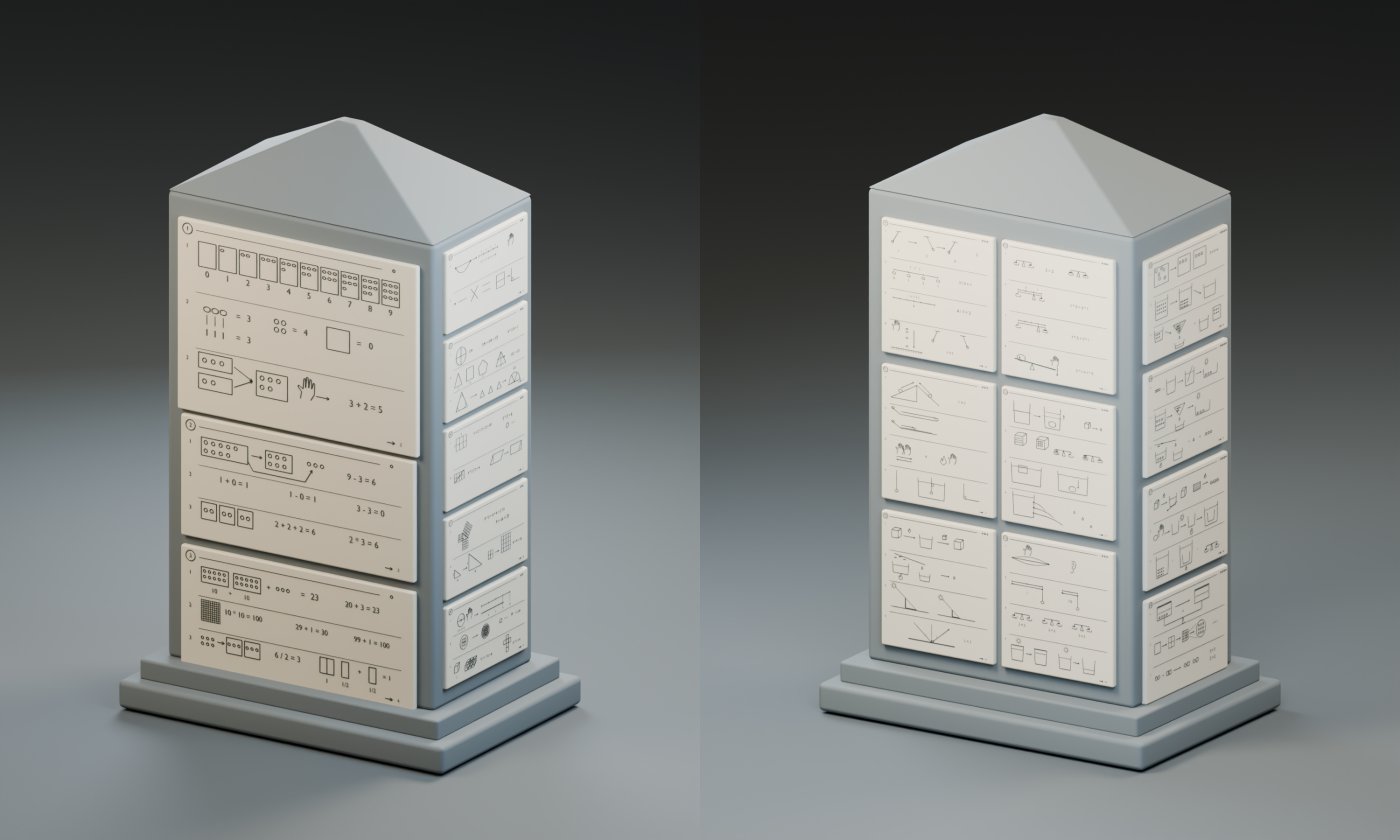
Earlier arithmetic draft
The original draft mapped tally marks to abstract numerals, defined equality, addition, subtraction, and multiplication through visual equivalence, and introduced base-ten scaling through powers of ten. It established the direction of the project and exposed the need for more physical demonstrations before compressed notation.
